cd ~/experiments/tiny-actors && less note.txt
A Thousand Tiny Actors
Language modeling without arithmetic: a random automata ensemble, a pinned optimum, and a champion that is mostly a lookup table
Abstract. We build a character-level language model whose dynamics contain no arithmetic: one thousand actors, each holding one of eight discrete moods, each consulting a personal random rule table over its own mood, three neighbors' moods, and the current character. Only a readout is trained, on identical text8 splits and readout code as the companion notes. Five results. (1) A control dial for criticality must heal rather than persist: biasing rules to keep the current mood cannot reach the ordered phase (a perturbed actor faithfully keeps its perturbation; the measured Derrida spread floors at ~1.5), while biasing toward a fixed home mood sweeps cleanly through the transition. (2) Under a ridge readout the bpc optimum is strictly subcritical (λ_D = 0.73), the interior-optimum result of the companion note, reproduced in the substrate where "edge of chaos" was coined. (3) Under a logistic readout the optimum does not migrate toward criticality; it is pinned at the same cell, and the logistic advantage is flat (0.40–0.46 bpc) across the entire dial, numerically matching the pure readout-calibration tax isolated in the funhouse note. The interference relief that moves reservoir optima has nothing to relieve here: discrete mood storage is crowding-free. (4) The best cell reaches 2.304 validation bpc with 2.2×10⁵ trained parameters, ahead of every tanh reservoir of comparable and larger size at the same data budget. (5) Deep in the ordered phase the ensemble is exactly a finite-state machine: state determined by the trailing 8 characters, 115,200 samples collapsing to 18,741 distinct states, with 2,336 states shared across suffix classes: partial automaton minimization by physics, as in the companion note's max-plus reservoir. The champion itself is 86% suffix-determined at depth 12: the best model in this program's weight class is mostly a lookup table.
§1 The machine and its dial
N = 1000 actors each hold a mood s_i ∈ {0…7} and watch m = 3 fixed random neighbors. Every step, all actors update synchronously by personal random rule tables: heterogeneity is the point; there is no shared law, no metric, and no arithmetic anywhere in the dynamics:
s_i(t+1) = rule_i( s_i(t), s_{n1}(t), s_{n2}(t), s_{n3}(t), c_t )
The character c_t is the prompt the whole stage hears. The trained readout sees only the moods (one-hot, N·k = 8000 features): ridge to one-hot targets with validation-fitted temperature, or multinomial logistic: the companion notes' readout code, unchanged. Criticality is measured, not assumed: λ_D is the mean one-step Hamming spread from a single flipped actor, post-washout.
The dial itself taught the first lesson. Our first bias (with probability β a rule entry keeps the actor's current mood) looks like a calm knob and is not one: a perturbed actor's "keep your mood" faithfully keeps the perturbed mood, so persistence preserves mistakes and the spread cannot fall below the self-persistence floor (measured λ_D = 1.54 at β = 0.9; the ordered phase is unreachable by construction). The working dial is typecasting: each actor has a fixed home mood that biased entries return to, so perturbations heal regardless of what they were. Measured λ_D then sweeps 3.41 → 0.39 as β runs 0.3 → 0.95, crossing criticality between β = 0.8 and 0.9. Stubbornness is not stability; order requires a restoring force, not inertia: the discrete cousin of the echo-state property.
§2 The edge, in its birthplace
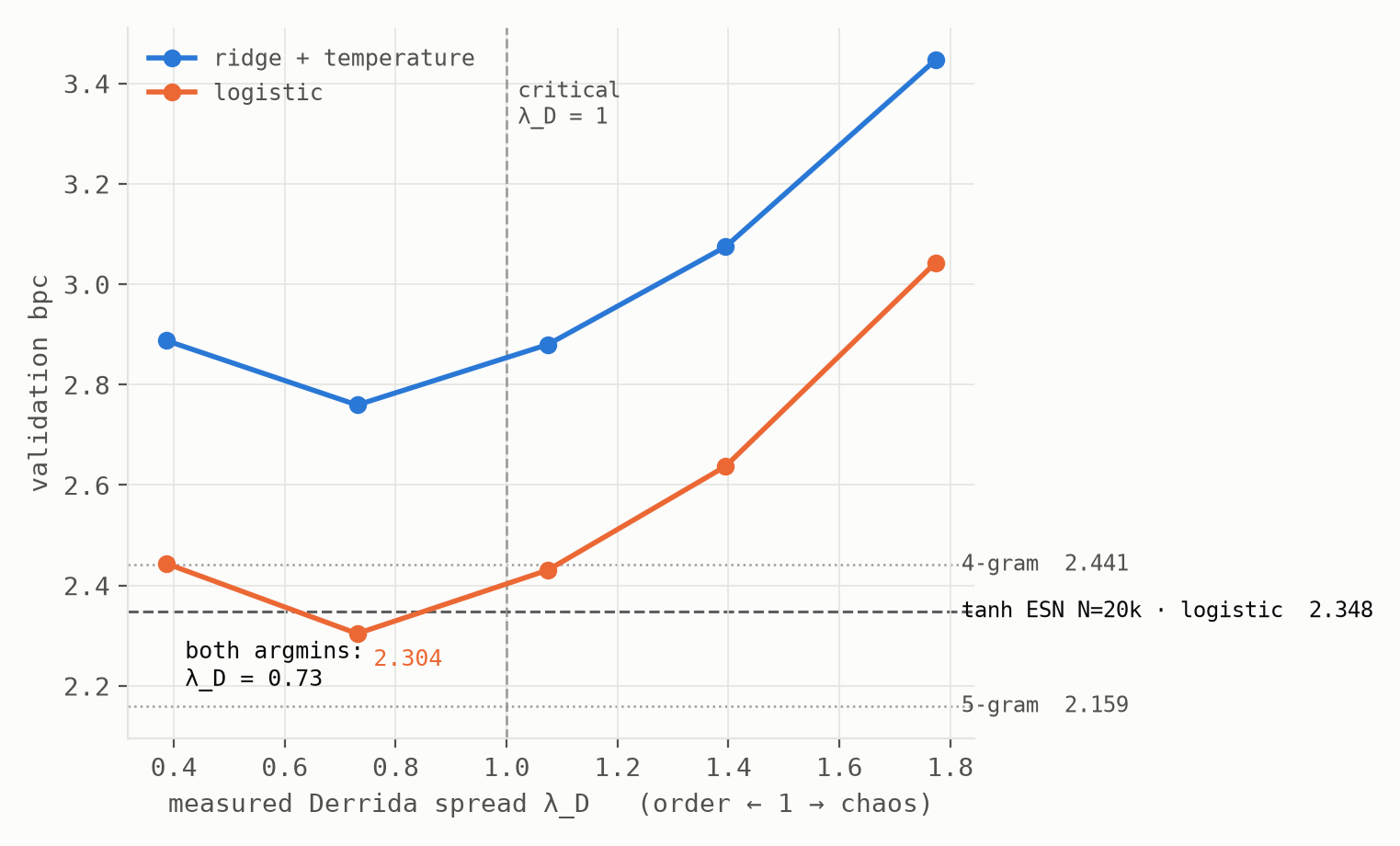
Random automata networks are where the edge-of-chaos hypothesis was born. The companion note found that language reservoirs tuned under a ridge readout reject the edge; the same experiment here (five cells straddling the measured transition, 2×10⁶ training characters each) reproduces it in the original substrate: validation bpc has an interior optimum at λ_D = 0.73, strictly inside the ordered phase, with both flanks rising (Fig. 1). The best stage keeps its actors mostly in character.
| model | val bpc | test bpc | trained params |
|---|---|---|---|
| 3-gram | 2.928 | 2.934 | ~2×10⁴ |
| troupe, ridge, λ_D=0.73 | 2.759 | 2.766 | 2.2×10⁵ |
| tanh ESN N=5k, logistic | n/a | 2.448 | 1.4×10⁵ |
| 4-gram | 2.441 | 2.436 | ~5×10⁵ |
| tanh ESN N=10k, logistic | 2.347 | n/a | 2.7×10⁵ |
| tanh ESN N=20k, logistic | 2.348 | n/a | 5.4×10⁵ |
| troupe, logistic, λ_D=0.73 | 2.304 | 2.318 | 2.2×10⁵ |
| 5-gram | 2.159 | 2.186 | ~1.4×10⁷ |
| tanh ESN N=50k, logistic (the program's leader) | 2.174 | n/a | 1.35×10⁶ |
The headline row: a thousand actors holding three bits each, wired by lookup tables, outscore tanh reservoirs holding ten and twenty thousand floating-point units at the same data budget, with fewer trained parameters than either. Caveat stated plainly: single seed on both sides of that comparison; the margin over N=10k (0.043) is several times the pond program's seed noise (±0.01) but a seed replication is the obvious next chore.
§3 The pinning: memory without crowding
The companion note's sharpest result was that its reservoir optimum migrates under a better readout: ridge prefers ρ = 0.6, logistic leaps to 0.95, because most of the high-memory penalty was interference a richer reader could relieve. The troupe refuses the move. The logistic argmin sits at the same λ_D = 0.73 as ridge (grid caveat: migration inside (0.73, 1.07) would be invisible), and (the sharper diagnostic) the logistic advantage is flat across the entire dial: 0.40–0.46 bpc everywhere, where the reservoir's gap grew five-fold with ρ (Fig. 2). Flatter still: the gap sits numerically on the pure readout-calibration tax (0.464 bpc) that the funhouse note isolated on provably feature-complete inputs.
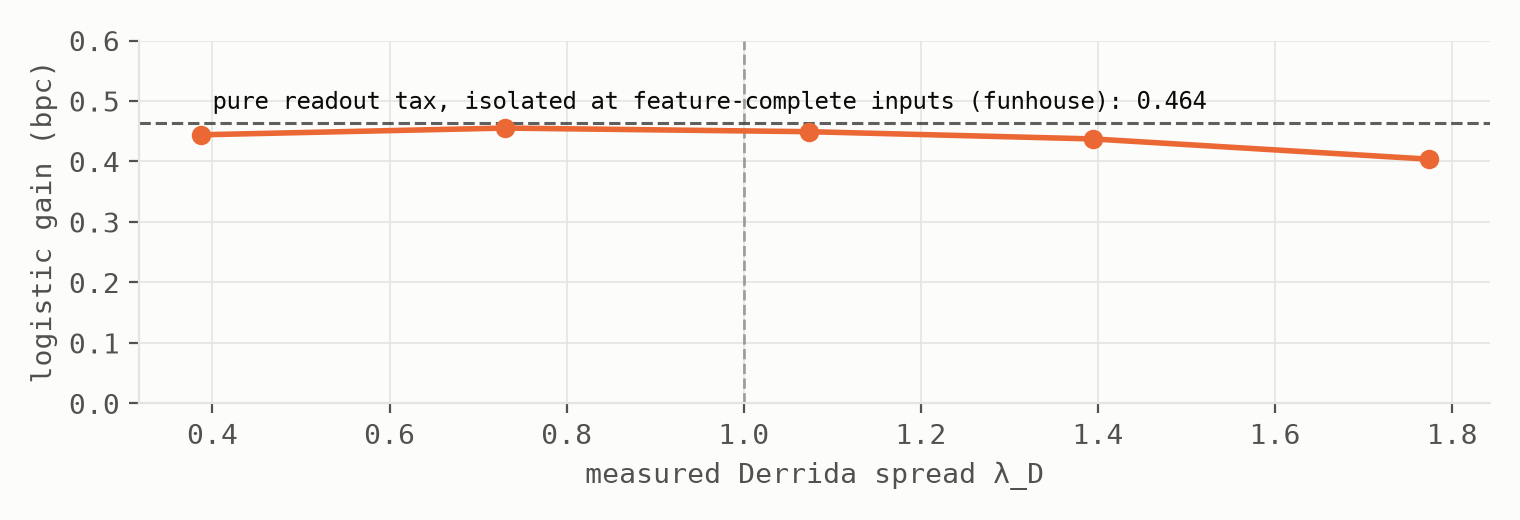
Reading: the reservoir pays two taxes: readout calibration, plus interference from memories superposed in a shared continuous state. The second is what a better reader relieves, moving the optimum. The troupe appears to pay only the first. Its moods are discrete; nothing is graded, nothing superposes, so there is no crosstalk for a better reader to untangle and nothing to migrate for. Crowding-free memory. §4 supplies the mechanism.
§4 The crystal: mostly a lookup table
Group sampled stage-states by the trailing k characters of input (115,200 samples per cell; only suffix classes with ≥2 samples count, exact 1000-actor vector equality required; a shift-by-one alignment control scores far below the aligned version, 0.615 vs 0.993). Deep in the ordered phase the ensemble is not approximately suffix-determined; it is exactly a finite-state machine (Fig. 3): at λ_D = 0.39, determinism reaches 1.000 at k* = 8, the 115,200 samples collapse to 18,741 distinct states, and 2,336 of those states are shared by multiple determined suffix classes, the dynamics merging equivalent histories on its own, the partial automaton minimization the companion note found in its max-plus reservoir, here reproduced in a rule-table substrate.
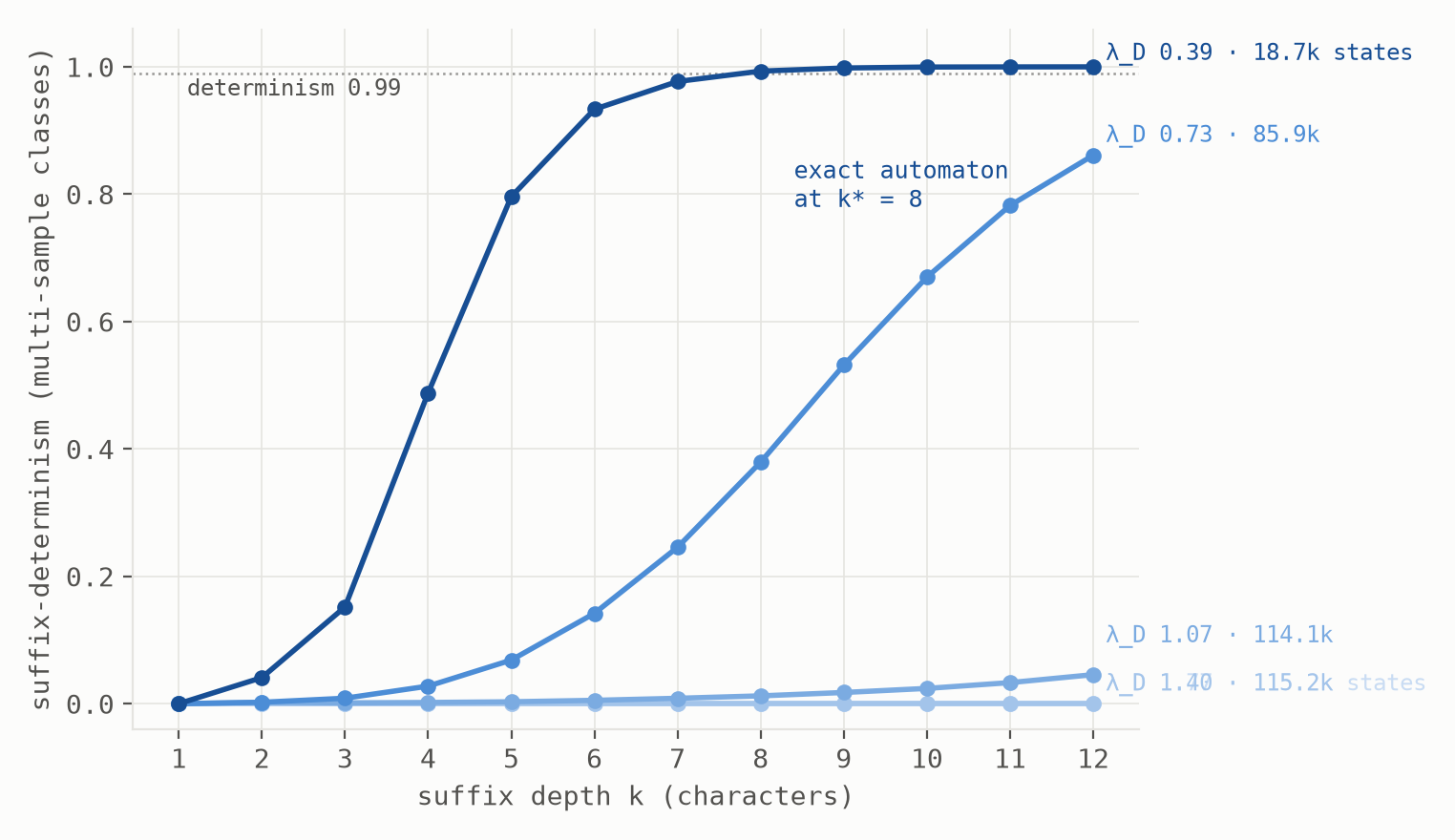
Toward criticality the crystal melts continuously (18.7k → 85.9k → 114.1k → all-distinct), the third substrate in this program to show the same discrete-to-fractal transition. And the two discretization routes differ mechanically: the max-plus reservoir's trajectories collide exactly in finite time (absorbing), while the troupe heals: differences die out under the typecast pull. A pre-registered mean-field form for that healing, det(k) ≈ exp(−D₀·λ_D^k), got the ordinal picture right (the champion should not and does not determinize by k = 12; the deep-subcritical cell should and does, k* = 8 vs. predicted 9.5) and the rate wrong in the favorable direction: measured determinism at the champion is 0.861 where the form predicts 0.023. Large perturbations heal far faster than the linearized Derrida rate: typecast pulls a wrong actor home regardless of its neighborhood, and λ_D, a small-perturbation growth rate, overestimates the survival of big differences.
The synthesis the title promises: the best model in this note, the one outscoring reservoirs five times its size, is 86% lookup table. It stores the recent past not by superposing it in a crowded continuous state but by healing into a configuration that stands for the recent suffix. That is why §3 found nothing to relieve: filing, not echo.
§5 Limitations and related work
Scope: one corpus (text8), character level, N = 1000 actors, k = 8 moods, one seed per cell (the pond-side comparisons in Table 1 are also single-seed at 2M characters); five dial cells, so migration inside (0.73, 1.07) is unexcluded; determinism results are within-sample (115,200 states) as in the companion note's automaton analysis. The λ_D = 0.73 optimum is a claim about these readout families and this budget.
Related work. Random Boolean networks and the Derrida annealed approximation: Kauffman; Derrida & Pomeau. Edge-of-chaos computation: Langton, Packard; computation at the edge in RBNs is the founding literature this note's §2 answers. Reservoir computing with cellular automata (ReCA): Yilmaz; Nichele & Molund, the nearest architectural antecedent, using uniform elementary CA rules; the troupe differs in per-cell heterogeneous rule tables, per-step symbol drive to every cell, a measured criticality dial with a healing (typecast) bias, and the geometry/determinism instrumentation. The interference framing and all baselines come from the two companion notes; the pure-readout-tax number is the funhouse note's. Fractal prediction machines and suffix-keyed state geometry: Tiňo et al.
Reproducibility: every run is seeded; result JSONs record full configurations; the lab journal contains each prediction's pre-registration text, including the copy-own dial's registered failure, the amended healing form, and both misses.